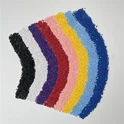
The plastic color matching process can be divided into the following steps, which are summarized as follows based on information from multiple sources:
I. Preliminary preparation
Sample analysis 1
Determine the type of plastic (such as PVC, PP, PE, etc.) and the molding process, and clarify whether special pigments such as heat resistance and weather resistance are required.
Analyze the color properties of the sample such as color light, hue, brightness, etc. through tools such as color cards and spectrometers3.
Demand confirmation
Communicate with customers about color requirements, including whether it is transparent, whether it contains fluorescent/metallic pigments, and whether it needs to match a specific light source (such as natural light, indoor light).
II. Formula design
Preliminary color matching 1
Select a reference object close to the standard color (such as a standard color card, a color-matched plastic sample), and adjust the pigment concentration and hue by visual inspection or instrumentation (such as a spectrophotometer)2.
Use the Munsell color system for calibration to ensure that the color properties (such as brightness and saturation) meet the requirements.
Formula correction 1
Prepare a small sample for physical coloring test, compare it with the standard color sample to adjust the formula, and iterate repeatedly until it is close to the target color1.
Consider the migration and dispersibility of pigments to ensure color uniformity during large-scale production.
III. Adjustment and Verification
Fine Adjustment 1
Make fine adjustments when close to the target color to avoid over-adjustment in the early stage, which will make correction difficult in the later stage.
Use color matching software (such as PeCoL) to simulate the color and assist in calculating the final formula.
Performance Verification 2
Test the final formula for heat resistance, weather resistance and other performance to ensure that it meets product requirements2.
Check the pigment safety indicators to meet environmental protection and industry standards3.
IV. Production Application
Batch Production
Determine the amount of pigment added (such as masterbatch, modified material) and process parameters, and establish a standardized formula system.
Monitor the production process to prevent color deviation due to equipment fluctuations.
Color Difference Control 2
If color difference occurs, it is necessary to analyze whether it is a formula problem or a raw material problem and make timely adjustments.
Provide a small sample for customer confirmation to ensure that the final product meets the agreement.
Note 5
Limitations of the trial and error method: Currently, most companies still use the trial and error method. It is recommended to combine instrument measurement (such as spectrophotometer) to improve accuracy.
Cost optimization: Under the premise of meeting performance, choose pigments with high cost performance.
Influence of light source: Indoor color matching needs to consider the difference between natural light and artificial light. It is recommended to confirm the color under natural light.
Through the above steps, plastic color matching can be systematically completed to ensure color accuracy and product performance.