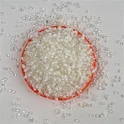
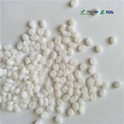
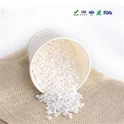
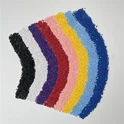
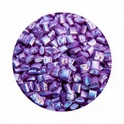
The production process of masterbatches is very strict, and the wet process is generally adopted. Masterbatch materials are made by aqueous phase grinding, phase turning, washing, drying and granulation, only in this way can product quality be guaranteed.
In addition, while grinding the pigment, a series of tests should be carried out, such as determining the fineness of the mortar slurry, determining the diffusion performance of the mortar slurry, determining the solid content of the mortar slurry and measuring the fineness of the color paste.
There are four methods of masterbatch production:
(1) Ink method: As the name implies, it is a production method of ink paste in the production of masterbatches, that is, through three-roller grinding, a low-molecular protective layer is coated on the surface of the pigment. The fine-colored paste after grinding is then mixed with the carrier resin, then plasticized by a two-roll plastic mill (also called a double-roll mill), and finally granulated by a single screw or twin screw extruder.
The process is as follows:
Ingredients: stirring, coarse color paste, three-roller grinding, fine color paste, two-roller plastic refining, extrusion and granulation
(2) Rinsing method: the pigment, water and dispersant are sanded to make the pigment particles less than 1μm, and through the phase transfer method, the pigment is transferred to the oil phase, and then dried to obtain masterbatches. Organic solvents are required for phase conversion, as well as corresponding solvent recovery devices. The flow is as follows:
Fine color paste rinsing, evaporation concentrate drying, adding carrier extrusion granulation
(3) Kneading legal: After mixing the pigment and the oil-based carrier, the pigment is flushed from the aqueous phase into the oil phase by kneading. At the same time, the surface of the pigment is coated by an oil-based carrier to stabilize the pigment dispersion and prevent the pigment from agglomeration.
(4) Metal soap method: is the pigment after grinding particle size of about 1μm, and at a certain temperature to add soap liquid, so that the surface layer of each pigment particle is evenly wetted by the soap liquid, forming a layer of saponification liquid, when the metal salt solution is added and the saponification layer on the surface of the pigment chemical reaction to generate a protective layer of metal soap (magnesium stearate), so that the finely ground pigment particles will not cause flocculation, but protect a certain fineness.
Mar 06, 2023
The Production Process Of Masterbatches
Send Inquiry