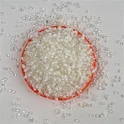
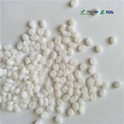
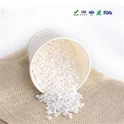
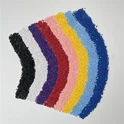
Therefore, dispersibility plays a crucial role in the quality of plastic products. So, what exactly causes poor dispersibility of color masterbatches? Is it entirely a problem with the color masterbatch itself? Let's analyze this in detail:
1. Influence of Pigment Characteristics: Pigment masterbatches are essentially high-concentration pigment polymers. Large amounts of powder agglomerating together can easily affect dispersion. This is especially true for pigments like titanium dioxide and carbon black, which have strong agglomeration properties and are prone to clumping. Therefore, rationally selecting the type and particle size of pigment based on customer product requirements and production processes is crucial for improving the dispersibility of the pigment masterbatch.
2. Static Electricity Interference: Some pigment masterbatches lack antistatic additives. During production, static electricity can easily be generated during the mixing and stirring of the pigment masterbatch and plastic raw materials. This can lead to uneven distribution of the pigment masterbatch in the raw materials, resulting in inconsistent product color.
3. Influence of Melt Flow Rate (Melt Index): Some pigment masterbatch suppliers choose resins with high melt flow rates (MFRs) as carriers to pursue better processing performance. However, a higher MFR is not always better; it is necessary to comprehensively consider product performance, surface quality, and processing requirements. A MFR that is too low will make it difficult for the pigment masterbatch to disperse sufficiently in the finished product; while a MFR that is too high may also affect other product properties. Therefore, rationally designing the MFR of the pigment masterbatch based on the characteristics of the carrier and pigment is crucial for improving dispersibility.
4. Impact of Addition Ratio
To control costs or ensure product performance, some color masterbatches are designed with low addition amounts. However, if the addition ratio is too low, the color masterbatch is difficult to disperse evenly in the plastic, easily leading to uneven coloring.
5. Impact of Dispersion System
During the production process of color masterbatches, dispersants and lubricants are usually added to help the color powder disperse evenly. If the dispersant is not chosen properly, it cannot effectively break up the powder agglomerates in the color masterbatch, resulting in poor dispersibility.
6. Impact of Density Difference
To enhance hiding power, high-density color powders, such as titanium dioxide (density approximately 4.0 g/cm³), are often added to color masterbatches. This density difference can easily cause the color masterbatch to settle at the bottom during stirring, failing to mix fully with the plastic raw materials, resulting in inconsistent product color.
7. Impact of Carrier Selection
The carrier of the color masterbatch is used to hold the color powder and other additives. Its type, variety, model, melt index, and morphology directly affect the processing performance and dispersion effect of the color masterbatch. Taking polyolefin products as an example, the choice of PP, PE, or EVA as the carrier, the use of a single carrier or a mixture of carriers, and the specific grade, melt index, and form (powder or granules) of the carrier will all affect the quality of the final product.
8. Impact of Production and Processing The production of color masterbatch involves multiple processes, from the selection of mixing equipment and processes, to granulation equipment, screw assembly, granulation processes, and even cooling processes. Differences in any of these stages will affect the final performance of the color masterbatch.