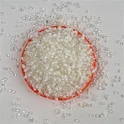
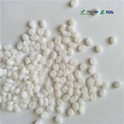
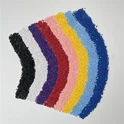
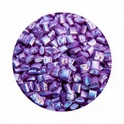
Adding metallic or pearlescent effects to plastic products primarily relies on adding special effect pigment masterbatches to the plastic base material, combined with appropriate processing techniques, specifically in-mold coloring (integral coloring).
Core principle: Pre-mixing metallic or pearlescent pigments with plastic resin, and then forming the product in one step through injection molding, extrusion, or other processes.
Advantages: Simple process, lower cost, more environmentally friendly (no post-processing required), and long-lasting effect.
Disadvantages: Metallic gloss is usually lower than electroplating, and fusion lines can easily occur due to uneven pigment distribution.
Typical applications: Automotive interior and exterior trim, home appliances, electronic product casings, cosmetic packaging.
To achieve a good pearlescent effect, the following three points are necessary:
Selection of effect pigments
Metallic effects mainly use flake-shaped metal pigments such as aluminum powder; pearlescent effects rely on pigments with metal oxide coatings on the surface of substrates such as mica (natural or synthetic). Pigment particle size and shape are crucial: larger particle size results in stronger sparkle but may reduce opacity; special geometric shape design helps reduce fusion lines.
Matching of base resin
The transparency of the base material directly affects the effect: transparent or translucent resins (such as transparent ABS, PC, PP) allow light to penetrate and reflect, producing a better, deeper metallic or pearlescent effect.
Control of processing technology.
This is the core of the technology, especially for in-mold coloring.
Mixing and dispersion: It is essential to ensure that the pigments are evenly dispersed in the resin to avoid agglomeration. Sometimes, special masterbatches are required.
Processing temperature and shear: Excessive temperature or strong shear force (such as excessive screw speed) may damage the structure of the flake pigments, leading to a decrease in gloss.
Solving the "fusion line" problem:
Fusion lines are the most common appearance defect in in-mold coloring. In addition to using specially designed pigments, this problem can be mitigated by optimizing mold design (such as changing the gate position), improving material flowability, and adjusting injection molding process parameters (such as temperature and speed).